
There was once a … limerick

English literature is rich in outstanding and gifted writers. One of the prominent authors and poets was Edward Lear. Though he was mostly an artist and illustrator, he became considerably popular and famous for his limericks.
A limerick is a short poem, usually consisting of five lines, with a humorous, witty and, sometimes, silly content. The history of its birth and name has lots of black holes. Most researchers believe that limericks appeared at some point in 18 century. Others claim that the earliest verses were already known in 11 century or even earlier, in folklore. But they all agree that the name, Limerick, has something to do with an Irish city or county.

A limerick is also referred to so-called nonsense literature (or literary nonsense). But please don’t think that there is no sense in such kind of literature, despite its name. There is. In fact, there is much more sense than in many modern works that do not belong to this genre.
Nonsense denies common sense, shows absurdity and inappropriateness of everything that happens in our lives, that happens to the world. And through this denial, a new world is born full of neologisms, inversions, portmanteaus, repetitions, puns and the like. It seems that nonsense doesn’t use word as a means of connection with the world but rather makes the relationship between the world and the word difficult. It throws sense and nonsense together, and such collision creates an excess of meaning and, as a result, humorous effect.
But let’s come back to our limericks.
Edward Lear was the one who popularized limericks. The story says that once Edward Lear was staying at a country house full of children. Those were the grandchildren of Lord Stanley, Earl of Derby, who had invited Lear to Knowsley Hall, the family estate, to make illustrations of his large collection of birds and mammals, reptiles, fish and eggs. Edward Lear accepted the invitation and his work at Knowsley Hall continued for 7 years, during which illustrations were not his only business. He also entertained the children of the estate making sketches, jokes, interesting characters and silly rhymes.
Later, these playful verses became the first Book of Nonsense full of bright, funny, silly and humorous limiricks. It was published in 1845, and its continuation – in 1872. He wrote about 212 limericks, mostly nonsense verse. But you might be surprised at the number of writers and poets having written limericks or, at least, tried, apart from Lear. Among them are Shakespeare, Lewis Caroll, H. G. Wells, T. S. Eliot, James Joyce, Rudyard Kipling, Alfred Lord Tennyson, Ogden Nash, W. H. Auden, Mark Twain, Dante Gabriel Rossetti, Robert Louis Stevenson, John Updike and many others.
By the way, we celebrate National Limerick Day Each year on 12 May alongside with the birthday of Edward Lear.
Another source of limericks, cheerful, funny, merry and playful, is Mother Goose Rhymes containing lots of children’s songs, chants and nursery rhymes in the form of a limerick. Nowadays, there’re endless videos with songs that all children love.
As to Mother Goose herself, a lot of speculations exist as to this character. Some historians think that she was a real woman and a widow living in Boston at the second part of 17 century. According to some sources, she bore a name of Elizabeth while others claim her to be called Mary. But there are researchers who have proofs that Mother Goose texts were a French creation going back as far as 10 century. And again, there are different theories: this figure can be a prototype of (can be based on) of the wife of King Robert II of France or she might also be the mother of Charles the Great, the King of Franks. As you can see, there is no common idea as to the origin.
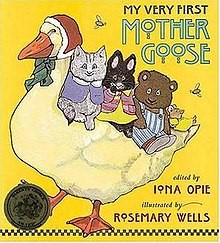
Anyway, despite the origin, Mother Goose nursery rhymes were translated from French into English and published both in the USA and Britain somewhere at the end of 18 century. Since then, many children in the world, and not only English-speaking ones, like listening to these amusing, energetic and exciting verses.
It should be noted that limericks nearly always evoke a smile. You could think that it is a very easy thing to write a limerick. But it’s not. And the main reason for that is that you have to stick to the rules. First of all, the true limerick should tell a story with a funny last line. And the standard form of a limerick has five lines. The first, second and fifth lines usually have eight or nine syllables rhyming with one another, and the third and fourth usually have five or six syllables, rhyming separately. They often contain hyperbole, onomatopoeia, idioms, puns, and other figurative devices. Though, I should mention that Edward Lear ‘s limericks had three or four lines depending on the space under the picture he drew for this particular verse.
In some cases, you can find a combination of a verse in a limerick with a refrain in order to create a limerick song, also known as a humorous drinking song with rude verses.
Have a look at the most famous limericks, and who knows… you might find yourself writing a limerick just in a couple of minutes from now!
Categories

 Jabberwocky Digest